
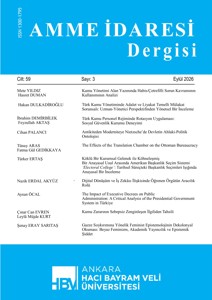
LAST VOLUME : Amme İdaresi Dergisi
NO : 3
RELEASE DATE : 2026-09-29
The concept of a wicked problem is an important analytical framework in public administration and public policy for examining complex policy problems that are difficult to define and address and that involve multiple actors, substantial uncertainty, and competing values. Although the concept has long been discussed in the international literature, no systematic study has comprehensively examined its patterns of use, methodological characteristics, and thematic distribution in Turkish public administration literature. This study therefore aims to examine the development and use of the wicked problem concept in Turkish public administration scholarship through a systematic literature review. A total of 29 scholarly works identified through Google Scholar and the Turkish Council of Higher Education National Thesis Center in accordance with predefined inclusion and exclusion criteria were examined in terms of publication type, year, research method and design, policy context, actors, policy instruments, and proposed response strategies. Although no date restriction was applied, all studies included in the analysis were published between 2020 and 2025, and no Turkish-language study published before 2020 was identified. In addition, 16 studies (55%) were coded as conceptual analyses. The findings indicate that Turkish scholarship on wicked problems is predominantly conceptual and qualitative and that the concept has been employed particularly in discussions of public administration and governance, COVID-19, disaster management, migration, and various urban policy problems. Collaboration, coordination, administrative capacity, adaptability, and multi-actor governance emerge as recurring themes. At the same time, the limited number of empirical and comparative studies and the concentration of publications within particular years and publication outlets indicate important methodological and thematic gaps in the literature. By systematically examining the existing body of Turkish scholarship, the study provides an integrated assessment of the current state and future research needs of wicked problem studies in Turkish public administration.
ARTICLES
An Analysis of the Use of the Wicked Problems Concept in Public Administration Literature
The concept of a wicked problem is an important analytical framework in public administration and public policy for examining complex policy problems that are difficult to define and address and that involve multiple actors, substantial uncertainty, and competing values. Although the concept has long been discussed in the international literature, no systematic study has comprehensively examined its patterns of use, methodological characteristics, and thematic distribution in Turkish public administration literature. This study therefore aims to examine the development and use of the wicked problem concept in Turkish public administration scholarship through a systematic literature review. A total of 29 scholarly works identified through Google Scholar and the Turkish Council of Higher Education National Thesis Center in accordance with predefined inclusion and exclusion criteria were examined in terms of publication type, year, research method and design, policy context, actors, policy instruments, and proposed response strategies. Although no date restriction was applied, all studies included in the analysis were published between 2020 and 2025, and no Turkish-language study published before 2020 was identified. In addition, 16 studies (55%) were coded as conceptual analyses. The findings indicate that Turkish scholarship on wicked problems is predominantly conceptual and qualitative and that the concept has been employed particularly in discussions of public administration and governance, COVID-19, disaster management, migration, and various urban policy problems. Collaboration, coordination, administrative capacity, adaptability, and multi-actor governance emerge as recurring themes. At the same time, the limited number of empirical and comparative studies and the concentration of publications within particular years and publication outlets indicate important methodological and thematic gaps in the literature. By systematically examining the existing body of Turkish scholarship, the study provides an integrated assessment of the current state and future research needs of wicked problem studies in Turkish public administration.
-
Authors: Mete YILDIZ - Hasret DUMAN
Page Number : 371-398
Keywords : H a b i s S o r u n l a r , Ç e t r e f i l l i S o r u n l a r , K a m u Y ö n e t i m i , K a m u P o l i t i k a s ı , A l a n Y a z ı n ı T a r a m a s ı
The Challenges of Fair and Merit-Based Recruitment Interviews in Turkish Public Administration: A Managerial Review from an Expert-Manager Perspective
The compliance with fairness and merit principles of recruitment interviews in Turkish Public Personnel Management is a subject of intense debate. This situation has led to questioning of the very existence of recruitment interviews done by public institutions and created a need to search how the recruitment interviews should be managed if they are maintained. Within the scope of the study, semi-structured interviews were conducted with 15 experienced individuals who possess expert knowledge in public personnel management and serve at least at the level of head of department in the personnel units of public institutions. The participants’ perspectives towards recruitment interviews were analyzed using phenomenological research method. The findings of the research indicate that recruitment interviews in public institutions play an indispensable role, at least for certain positions. This study offers concrete recommendations for the institutionalization of recruitment interviews in public institutions based on the principles of fairness and merit.
-
Authors: Hakan DULKADİROĞLU
Page Number : 399-434
Keywords : K a m u , i ş e a l ı m , a d a l e t , l i y a k a t , m ü l a k a t
Rotation Implementation in Turkish Public Personnel Regime: Social Security Institution Experience
In the study, the ‘rotation’ application known as ‘appointment via relocation’ in the official terminology of the Turkish public personnel regime was examined. The rotation application, which is examined specifically in the context of the Social Security Institution (SGK/Institution), has been subjected to with holistic approach. The application inherent in the Turkish public personnel regime is related to the mandatory assignment of public personnel subject to the application in regions separated into certain administrative groups for certain periods in line with the characteristics of the public service and the economic and social structure of the country. In this context, mandatory appointment via relocation, known as rotation, is essentially related to the provision of public service within a fair and balanced system. Although the application of appointment by relocation in the Turkish public personnel regime is a practice that has been in place for more than half a century, it is relatively more recent in the context of the SGK. With this study, where the application was evaluated in terms of the SGK experience, the place and importance of the application within the public personnel regime as well as the functionality of the SGK application were examined. In the study, the history of my SGK experience, its evolutions, its functionality and its positive and negative results were analyzed as a whole, and efforts were made to clarify the approaches to solve the identified problems. Another purpose of the study is to clarify the approaches to the development and improvement of the application inherent in the Turkish public personnel regime, specific to the institution's application. This study on the appointment by relocation inherent in the Turkish public personnel regime, specific to the SGK experience, is also important in terms of filling the literature gap on the subject.
-
Authors: İbrahim DEMİRBİLEK - Feyzullah AKTAŞ
Page Number : 435-470
Keywords : K a m u p e r s o n e l r e j i m i , K a m u p e r s o n e l i , A t a n m a , Z o r u n l u y e r d e ğ i ş i k l i ğ i , R o t a s y o n
The Moral-Political Ontology of the State in Nietzsche: From Antiquity to Modernity
The question of whether Nietzsche can be classified as a political philosopher and whether he possesses a systematic theory of the state is a subject of intense debate in the international literature. However, this debate has been relatively neglected in the Turkish literature; the perspectives the philosopher offers on political philosophy have not been sufficiently examined. Yet, upon examining Nietzsche’s body of work, the existence of a multilayered and profound conception of politics and the state becomes clearly evident. Nietzsche’s arguments regarding the ontology of the state set him apart from the contractualist tradition. For Nietzsche, the state manifests itself not primarily through a dynamic based on consensus, but rather through the dynamics of conflict, domination, and obedience. The state also carries out its process of institutionalization through the mediation of apparatuses of violence and consent, by domesticating reason and morality. According to him, human beings, by virtue of their ontological priority, are not ‘political animals’ (zoon politikon) but ‘moral animals’ (zoon ethikon). Educational processes spanning millennia, theological teachings, traditional institutional relationships, and disciplinary practices of violence have constructed a specific culture and typology of agents. The political dimension of the social has also been shaped through the filter of this historical process.
-
Authors: Cihan PALANCI
Page Number : 471-494
Keywords : N i e t z s c h e , d e v l e t , s i y a s e t , a h l a k ı n p o l i t i k l e ş t i r i l m e s i
Tercüme Odası’nın Osmanlı Bürokrasisi Üzerindeki Etkileri
Bu çalışmada Osmanlı modernleşmesinin bir izdüşümü olarak Tercüme Odası’nın kuruluşu ve Oda’dan yetişen bürokratların geç Osmanlı döneminde yönetim kademelerindeki etkileri tartışılmıştır. Osmanlı bürokrat zümresinin Tanzimat Dönemi’ndeki yükselişi düşünüldüğünde bu konu hem bir hayli ilgi çekici hem de üzerinde yeterince durulmamış bir konudur. Literatürde Tercüme Odası ile ilgili çalışmalar bulunsa da odanın yükselen Osmanlı bürokrasisi üzerinde nasıl bir etkiye sahip olduğuna dair bir çalışma bulunmamaktadır. Bu sebeple çalışmada söz konusu bürokratların Tercüme Odası’ndan edindikleri yeteneklerden istifade ederek nasıl yükseldiklerine ve birçok bürokratik mevkii nasıl domine ettiklerine değinilmiştir. Çalışmanın diğer bir odağı ise üretim ilişkilerinin dönüşümüne bağlı olarak gelişen kapitalist koşullar altında bürokratik kadrolara duyulan ihtiyacın karşılanması için Tercüme Odası’nın görmüş olduğu işlevi ortaya koymaktır. Çalışmada ilk olarak Tercüme Odası kurulmadan önce Osmanlı İmparatorluğu’nda tercümanlık işlerinin nasıl yürütüldüğü mevcut literatür doğrultusunda değinilmiştir. İkinci alt başlıkta Yunan İsyanı/Bağımsızlık Savaşı’ndan sonra kurulan Tercüme Odası’nın kuruluş ve gelişim aşamaları açıklanmıştır. Üçüncü alt başlıkta Osmanlı bürokratik modernleşmesinde Tercüme Odası’nın gördüğü işlev açıklanmıştır. Çalışmanın son bölümünde ise 1830’ların ikinci yarısından itibaren Osmanlı İmparatorluğu bürokrasisi içerisinde ağırlığını hissettirmeye başlayan Tercüme Odası memurlarının hangi bürokratik mevkilere atandığı, Osmanlı bürokrasisi ve modernleşmesi üzerinde nasıl bir etkide bulunduğu, Başbakanlık Osmanlı Arşivleri’nde bulunan ve Osmanlıcadan tercüme edilen belgeler doğrultusunda değerlendirilmiştir.
-
Authors: Tünay ARAS - Fatma Gül GEDİKKAYA
Page Number : 495-524
Keywords : T r a n s l a t i o n i n t h e O t t o m a n E m p i r e , T r a n s l a t i o n C h a m b e r , O t t o m a n B u r e a u c r a c y , M o d e r n i z a t i o n
Between a Deep-Rooted Institutional Tradition and an Outdated Constitutional Procedure – the American Presidential Election System ‘Electoral College’: A Constitutional Analysis in Light of Presidential Elections Throughout History
The American constitutional system, which serves as the prototype for the presidential system of government, reflects the institutional and personal separation between the legislative and executive branches. One manifestation of this separation is the method of electing the President. In the American political system, the President, who holds executive power, is elected through a process in which Congress, the legislative branch, does not participate. Thus, the American President derives his democratic legitimacy and electoral mandate directly from the people. However, the President is not directly elected by the people either. According to the electoral system designed by the Framers who drafted the American Constitution of 1787, The President and Vice President are elected through a system of state-based electoral votes. Under the current Electoral College system, the people elect the electors, who then elect the president. This system was designed to increase the role of the states in electing the president, while also seeking to mitigate potential partisan factions between presidential candidates and the people. In this respect, the presidential election system reflects the principle of limiting the political majority and branches, which is a characteristic of the American constitutional order. Nevertheless, there is also intense criticism that this system is outdated in the contemporary political context and problematic in terms of democratic principles. Indeed, as a result of the electoral system, the candidate with the most votes nationwide may not be elected president.
-
Authors: Türker ERTAŞ
Page Number : 525-560
Keywords : 1 7 8 7 A m e r i k a n A n a y a s a s ı , A m e r i k a n B a ş k a n ı , K u v v e t l e r A y r ı l ı ğ ı , S e ç m e n l e r / D e l e g e l e r K u r u l u , S a d a k a t s i z D e l e g e
The Mediating Role of the Learning Organization in the Relationship between Digital Transformation and Business Intelligence
Digital transformation is regarded as a strategic domain for strengthening data-driven governance, improving organizational processes, and restructuring decision-making mechanisms in public institutions. Business intelligence systems play an important role in translating digital transformation into organizational value, and this effect is expected to emerge through mechanisms such as organizational learning capability. This study aims to examine the mediating role of the learning organization in the relationship between digital transformation and business intelligence. The research was conducted using a quantitative approach with a sample of 255 employees of PTT Inc. Data were collected through an online questionnaire. The validity and reliability of the measurement model were tested using confirmatory factor analysis, and the relationships among the variables were analyzed through structural equation modeling. The findings reveal that digital transformation positively affects both business intelligence and the learning organization, while the learning organization also has a significant positive effect on business intelligence. In addition, the learning organization was found to play a significant mediating role in the relationship between digital transformation and business intelligence. The results indicate that supporting digital transformation initiatives with a learning culture and knowledge-sharing mechanisms may enhance organizational value. By examining the relationship between digital transformation and business intelligence from the perspective of the learning organization in the public sector, this study contributes to the literature and highlights the importance of integrating digital transformation initiatives with organizational learning and knowledge-sharing mechanisms.
-
Authors: Nazik ERDAL AKYÜZ
Page Number : 561-592
Keywords : D i j i t a l d ö n ü ş ü m , İ ş z e k â s ı , Ö ğ r e n e n ö r g ü t , K a m u s e k t ö r ü , Y a p ı s a l e ş i t l i k m o d e l l e m e s i
Yürütme Kararnamelerinin Kamu Yönetimine Etkisi: Türkiye’deki Cumhurbaşkanlığı Hükümet Sisteminin Eleştirel Bir Analizi
Bu çalışma, 2017 Anayasa değişiklikleriyle yürürlüğe giren Cumhurbaşkanlığı Hükümet Sistemi’nde (CBHS) Cumhurbaşkanlığı Kararnamelerinin (CBK) Türk kamu yönetimi üzerindeki dönüştürücü etkisini normatif hiyerarşi, örgütsel yapı ve personel rejimi ve çerçevesinde analiz etmeyi amaçlamaktadır. Bu amaç doğrultusunda Hans Kelsen’in ‘Normlar Hiyerarşisi’ teorisi esas alınarak 1982 Anayasası, 703 sayılı KHK ve temel CBK’ler nitel araştırma yöntemlerinden içerik analizine tabi tutulmuştur. Yapılan analiz, yürütmenin genişleyen ‘mahfuz alanıyla’ CBK’lerin asli nitelik kazandığını, buna karşın dijital çağ yönetişiminin ‘hız ve esneklik’ vaadinin uygulamada ‘hız paradoksuna’ ve idari istikrarsızlığa dönüştüğünü göstermektedir. Bunun yanı sıra Devlet Personel Başkanlığı (DPB) ve Türkiye ve Orta Doğu Amme İdaresi Enstitüsü’nün (TODAİE) kapatılması, Pollitt’in ‘kurumsal unutkanlık’ ve Peters’ın ‘kurumsal erozyon’ kavramlarıyla açıklanan uzmanlık ve hafıza kayıplarını somutlaştırmıştır. Üst kademe yöneticilerin ve valilerin görev süresinin doğrudan Cumhurbaşkanına endekslenmesi ise idarenin kanuniliği ve tarafsızlığı ilkeleri bakımından liyakat-sadakat dengesini tartışmalı hale getirmiştir. Sonuç olarak çalışma, CBK’lerin statüsünü ‘karma görüş’ çerçevesinde değerlendirmekte olup, rasyonelliği, bürokratik tarafsızlığı ve kurumsal hafızayı güvenceye almak adına ABD’deki MSPB örneğine benzer bağımsız bir ‘Liyakat Koruma Kurulu’ kurulmasını, üst kademe yönetimin kanunilik ilkesiyle uyumlaştırılmasını ve yasama denetiminin pekiştirilmesini kamu yönetiminin sürdürülebilirliği açısından önermektedir.
-
Authors: Aysun ÖCAL
Page Number : 593-618
Keywords : P r e s i d e n t i a l G o v e r n m e n t S y s t e m , P r e s i d e n t i a l D e c r e e s , H i e r a r c h y o f N o r m s , I n s t i t u t i o n a l M e m o r y , M e r i t P r o t e c t i o n B o a r d
Recovery of Public Loss from the Party Unjustly Enriched
This article aims to examine the legal issues concerning the recovery of public loss from the party who has been unjustly enriched, within the scope of Article 71 of the Public Financial Management and Control Law No. 5018 and the Regulation on the Procedures and Principles Regarding the Recovery of Public Losses enacted pursuant to this article, with reference to the case law of the Council of State, the Court of Cassation, and the Court of Jurisdictional Disputes. From this perspective, the subject of the study seeks to fill an interdisciplinary gap at the intersection of public (financial) administration, administrative law, and the law of obligations. Indeed, in the existing literature, the concept of public loss has mostly been addressed in the context of the compensation liability of the public official (the liable party) who caused the public loss, and there is no study focusing on the restitution obligation of the relevant party based on unjust enrichment.
-
Authors: Çınar Can EVREN-Leylâ Müjde KURT
Page Number : 619-646
Keywords : K a m u Z a r a r ı , İ l g i l i , S e b e p s i z Z e n g i n l e ş m e , Y e r s i z Ö d e m e , F a z l a Ö d e m e
A Decolonial Reading of Feminist Epistemology in Relation to the Gaza Genocide: White Feminism, Academic Publishing, and Epistemic Violence
This study examines, from a decolonial perspective, how the Gaza Genocide is positioned within the feminist episteme and through which institutional and epistemic mechanisms the resulting epistemic silence is produced. Although feminist scholarship conceptualizes genocide as a gendered practice of power and one of the most severe forms of violence against women, the limited attention given to the ongoing genocide in Gaza since 7 October 2023 within feminist academic literature constitutes the primary motivation of this study. To address this question, a total of 4,785 articles published between 2024 and 2025 in women’s studies journals affiliated with Taylor & Francis and Wiley, which function as epistemic centres within the field of international academic publishing, were examined through conceptual and contextual content analysis. The findings reveal that only 34 of these articles addressed the Gaza Genocide either directly or indirectly, corresponding to a visibility rate of merely 0.71%. The results indicate that the Gaza Genocide has been positioned as a marginal and exceptional issue within the feminist literature, has failed to develop into a systematic field of inquiry, and has largely been addressed through specific journals, special issues, or editorial initiatives. The study argues that this situation reflects not a passive or incidental silence, but rather a structural form of epistemic silence that renders experiences of violence in particular geographies invisible within processes of academic knowledge production. In this respect, the case of the Gaza Genocide provides a critical example of how feminist knowledge-production processes determine which forms of violence are rendered visible and which are excluded from the epistemic domain. Ultimately, the study exposes the selective modes of knowledge production embedded within mainstream feminist epistemology, contributes to debates on epistemic silence and epistemic violence from a decolonial perspective, and points to the need to rethink the conditions of knowledge production and circulation in relation to colonialism.
-
Authors: Şenay ERAY SARITAŞ
Page Number : 647-672
Keywords : G a z z e S o y k ı r ı m ı , d e k o l o n y a l y a k l a ş ı m , f e m i n i s t e p i s t e m o l o j i , e p i s t e m i k ş i d d e t , a k a d e m i k y a y ı n c ı l ı k